Wednesday, January 8, 2014

SHANIA TWAIN INSANITY

My mother and I have always loved Shania Twain. We blast her songs in the car and manage to scream over Shania's wails. We've done it my whole life. Shania has something of a mythic status in my family. I never learned the lyrics to her songs. They're in my blood, it feels like. Which is why I helped organize--and pay for--a trip to Las Vegas to see her for my mom's birthday. I just knew that it would be one of the best concerts of my life. And I wasn't disappointed. 

But this isn't a concert review. This is a story. A story about passion and nerdiness and how purely, unabashedly loving something can pay off sometimes.

It begins with a little bit of backstory, or, rather context. You see, my parents are strange people who spend money on strange things. They won't pay their bills on time for months, but they'll buy a new speedboat. They'll go on weeks long vacations, but be too cheap to buy paper towel. And they'll almost always pay for concerts. As a result, I've seen a lot of them, Great Big Sea in particular, a band with such amazing fans and such joyous, lively concerts. People jump and dance and clap and scream and it is always so much freaking fun. Some concerts I go to, however, are…more demure. More strange. One Martina McBride concert, in particular, stands out. My dad and I go expecting an excited crowd, but instead, Happy Girl comes and all it gets is a polite applause. Like really, people? It's Happy Girl! And why did you come all this way, why did you pay for these tickets, why are you spending time here if you don't love Happy Girl?!?!? 

Going into the Shania concert, I wasn't sure what to anticipate from the crowd. Given that this was a Caesar's Palace show, I figured there would be some people who had just come because that's what you do in Vegas. I figured most hadn't come from as far as Toronto, certainly. So, I knew the crowd wouldn't fall on the Great Big Sea end of the crowd passion spectrum. But I thought that, since the tickets were pretty expensive, the crowd reaction would be closer to GBS than Martina McBride. And I was soon realized I was wrong. And then I decided I didn't care. And I danced and screamed and cheered as loud as I could anyways. Because I had come all this way and I had listened to these songs for so long. And yeah, I was self conscious for a bit, but, soon, I didn't care. I was proud of my passion. Because it's whole lot more fun to passionate and excited and out of control in love with something than it is to respectfully clap every once and a while. So, as Shania sang I'm Gonna Getcha Good and Whose Bed Have Your Boots Been Under and the crowd around me sat stone faced, I threw myself into the music. These were not just songs I listened to, after all. They flowed through my veins. 

This being Caesar's Palace, even $150 dollars each only bought us fairly nosebleed seats, but really, I didn't care. I was just so happy to hear Shania. Seeing her up close was an afterthought entirely. I was over the moon, even if I was a million miles away. I had been waiting for this my whole life. I wasn't going to waste a second of it. 

Suddenly, I felt a tap on my shoulder. The usher lady wanted to speak to me in the hall. I was freaked out, but I figured I had broken some rule. Standing too much. Cheering too much. I had the wrong seats. Whatever. Being a fairly loud, socially awkward person, this happens in my life. Mostly, I was annoyed that I had to miss part of Don't Impress Me Much. But then the usher explained that I had seemed so into to the show and that there were some empty seats down on the first level and would I like them? The answer in my head was instantly yes. And yes, I had that terrible person moment, considering if I could go down without my mother. But when I explained I was with someone, she didn't blink an eye. Of course, in retrospect, I guess they wouldn't just offer one seat. Most people go to concerts with another person. But in the moment, it all felt so unreal that logic had kind of left the building. In all the concerts I've been to in my life, nothing like this has ever happened to me. Being a short person, I've long resigned myself to not being able to see the actual musicians on stage at all, a problem which is made much worse when some person near the front of the crowd decides to hold up a Newfoundland flag for the entire show, because, apparently the band doesn't know where they're from and, bonus, this person has freakish upper body strength. That is the type of thing that happens to me. Not the "hey, you want a seat upgrade?" thing. Not ever. 

So, of course, I said yes, and ran back to get my mom. Of course, I had to check to see what song she had just started. Thankfully, it was only a really good one and not a great one. Still, I had to resist the urge to run down to the first level. As I forced myself to walk, I ran the lyrics in my head. There was no way I was missing more than one song. Especially since there was no knowing what the next one would be. 

They forced us to wait outside until a song break, which was deadly. I decided to take the moment to go to the bathroom, though that nearly killed. I literally sprinted to the bathroom and back. I was not missing more than one song. Over my dead body. When I made it back (in time!), everyone was staring at some guy at the other first level entrance. Shania's husband, apparently. Which was a little weird. 

Anyways, I was thinking they were going to put us somewhere near the back of the first level. Still a significant distance from the stage. But when the usher girl FINALLY let us back in, she placed in the first section! The back of the first section but still. Those are still freaking $500 seats. That people had bought and not bothered to show up for! And besides, it turned out to be great positioning, because Shania actually walked up and down the aisles. Meaning, at one point, she was less than a foot away from me! She was shaking people's hands, and I had even worked up the courage to offer her mine, but she turned her back to me just as she passed. But, dear god, who cares? Shania freaking Twain was less than a foot from me! And I was the first section at her concert! Nothing else in the whole world mattered in that moment. 

And yeah, the concert went off from there. They dropped confetti, which, on the first level, I could actually catch. And I could see everything. And my mom and I both enjoyed it so much. It was absolutely amazing. Way more than we ever dreamed of. All because of passion and a lack of self-consciousness. It was a great experience. And it was also so great that being passionate about something, without any shame or holding back, could actually be validated. Rewarded. In the best way I could imagine. In one of the best nights ever. 

So often, I feel self-conscious about loving the things I love (don't we all?). And in that moment when I first stood up to dance, I was overcome with self-consciousness. But I am so freaking glad I ignored it, so freaking glad I allowed myself to be the insane Shania fan I am. Because, it turns out, sometimes passion does pay off. Who knew. 

A lot of this post is just me insanely fan girling, at the cost of the good (or mediocre or whatever my work usually is) writing, so I'll leave you with the words of a man who is always a much better writer than me: 
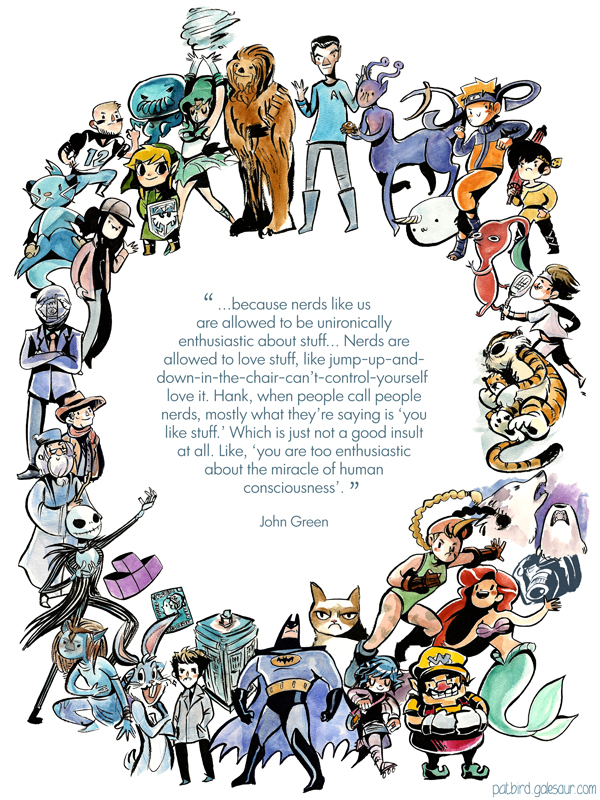

(Can I write a post without quoting or linking or at least referencing John Green? No matter what I say about TFIOS and nerdfighteria, I think not. But hey, it's good to be passionate about things, not matter what--or who--that thing is. Haven't you been following along?)

Thursday, January 2, 2014

TFIOS: Redux

I love The Fault in Our Stars (TFIOS, for the uninitiated). Or, at least, I think I do. At this point, I can't really tell. All I know is that I'm supposed to. Which feels really weird.

For years, I bemoaned the fact that the things I love don't have great fandoms. Yes, YA has fantastic book blogs, there's no denying it, but it doesn't have the insane, paraphernalia friendly type of fan culture, like Star Wars or LOTR or Doctor Who or even freaking Adventure Time (like really? What is that? An animated show gets action figures and we don't? Come on!). Of course, the term "YA" encompasses a much more vast, overarching, generalized community than, say, the fan base surrounding one specific movie or book series. But even authors like Sarah Dessen or Meg Cabot, who are YA gods, don't have that type of following. And then came John Green.

I became a nerdfigher slowly. Reluctantly. When I read John's books, I wasn't one at all. I picked up Looking for Alaska with a completionist goal in mind, trying to stay up on the current trends in YA. This was pre-TFIOS, but John's books were still pretty hot back then, so much so that I felt I had to read them to keep up my YA credibility, the same logic which motivated me to read Twilight, Harry Potter, The Hunger Games, and all of Elizabeth Scott's novels. And here's the thing: I didn't even like Looking for Alaska! I did quite like An Abundance of Katherines and Paper Towns, however; enough so that I took the time to google John Green to see if, perhaps, he had a blog. He did not. But he did have a vlog. I started with Vlogbrothers, of course, quickly adding The Lizzie Bennett Diaries, Hankschannel, Emma Approved, occasionally Hank Games and Mental Floss, as well as associated creators such CGP Grey, Charlie McDonnell, Alex Day, Rosianna Halse Rojas, and Carrie Hope Fletcher. I added each without really thinking about it. They were simply things I enjoyed watching--it never really occurred to me that the watching of them would affect me in any way. I never considered that slowly, but surely, by watching all these channels and then following John and Hank on tumblr and then listening to Hank's music and then getting DFTBA posters for my bedroom walls, I had become….a nerdfighter?

It's a label I'm not exactly comfortable with, not one I fully identify with, but one you could certainly identify me as given my interests and internet habits. Which feels really strange. There have been a few times when I myself used the label as a sort of shorthand, but it's always felt kind of strange coming out of my mouth. Disingenuous. Unearned. A wrong fit. Conversely, identifying myself that way has sometimes made me feel like a fangirl. In that way, the label was embarrassing. Shameful. Either way, it has been a label I have resisted.

But, ultimately, it wasn't the label that made me question myself. It was how I started reacting to things. Originally, I was a fan of the things--the books, the music, the Youtube videos--and the fandom just came along with that. Now, though, as much as resist the "nerdfighter" name, I fear that I may be reacting as part of the fandom, rather than as a genuine fan with a passion for that specific thing. Specifically, TFIOS.

I really liked TFIOS when I read it. At least, according to my review I did. Yet, now, somehow, I find it hard to remember. Now, it's hard to figure out if I like TFIOS because I'm caught up in the hype and the adoring spirit of nerdfighteria, or if I actually like the book because of my own experience reading it. Unlike most books, I don't really have a personal relationship with TFIOS as much as I have a collective relationship with it. Whereas, with other novels, I reread parts only in the dead of the night or as a treat when I wake up on a lazy Sunday morning or when I'm really upset and need a source of comfort, with TFIOS, I don't seek it out in the same way. Instead, I follow John's tumblr and the TFIOS tumbler and visit the DFTBA website, and, of course, watch the Vlogbrothers videos. Instead of finding the quotes myself, digging through the book like I normally would to find that line or paragraph or moment that stood out to me, that touched me personally in some way, I find myself rereading the quotes that other people selected, that mattered to other people, that touch people most in nerdfighteria as a whole. I don't think this an inherently negative difference. But it is sort of a fascinating difference.

When I see the TFIOS movie poster or the TFIOS audiobook read by John Green, I instantly want those things. And I almost order them and I almost order them, and then I question myself: why do I want this thing? Is it because I love the book or because I'm supposed to love the book? Is it because I want to prove that I'm a nerdfighter or because I actually am one? Is that something I want to be? What does it mean that I want this thing?

All these questions! I don't have questions like this with Sarah Dessen or Stephanie Perkins' novels. Because, in this unique case, it's not just my interpretation of the novel that gives it meaning--to use a John quote, "books belong to their readers"--but the group's interpretation. And, while I'm still finding my place in this group--or perhaps outside of this group--it seems the questions will remain unanswered.

Friday, December 27, 2013

A (Sort of) Review of Eleanor and Park

Confession: I didn't love Eleanor & Park. I enjoyed it. I respected it. I appreciated the unfortunately unusual/refreshingly realistic diversity in race, class, and body image. But it didn't spark anything particular for me. I know that's a terrible thing to say, when every YA book out there is now selling itself "for fans of John Green and Rainbow Rowell", when every YA book blogger is falling over themselves to write a glowing review of it, when John Green himself gushes about it in the freaking New York Times. I wanted to love it, I swear. But I only liked it. And I think I finally figured out why.

For me, I think it comes down to reread-ability. Though this is something I do all the time, rereading the romantic parts of my favourite novels, I had never considered it as an actual measure of a book's quality. But I was talking to my friend the other day and it suddenly clicked. You see, I was lending her Fangirl, a Rainbow Rowell book that I actually did love, telling her over and over how much I loved the romance and the writing and how I just had to underline certain lines and reread certain parts again and again and again like a crazy person. And I realized that I've never done that with Eleanor & Park. I finished it, filed it away on my bookshelf, and only took it out so I could lend it to that same friend when she explicitly requested it because she had heard so much hype about it online. I barely thought about it after I finished the last page. Nothing drew me to it again, which is strange, since it's not like all the books I do chose to reread are of better--or even good--quality. Since I've come home for Christmas break, I've reread Simone Elkeles' Perfect Chemistry, Caridad Ferrer's Adios to My Old Life, and Lauren Morrill's Meant to Be, all of which are of lesser literary quality than Raibow Rowell's YA debut. Yet even now, as I pick up Eleanor & Park to make sure, one last time, that I do not want to reread this book, that it hasn't simply been my laziness or the plethora of other books I have to reread or the various distractions of life, it proves me right. Because once again, I begin flipping through, rereading sections and snippets, and nothing grabs me. Just like before. Nothing's changed. 

Sometimes, I can't stop myself from rereading certain scenes of books even before I've finished the freaking book. This happened with Leah Rae Miller's The Summer I Became a Nerd, a book which completely snuck up on me and completely stole my heart and has remained a monthly, if not weekly, reread since. Sometimes, it happens a few weeks or even months after I've finished the book, as was the case with Stephanie Perkins' Lola and the Boy Next Door. Immediately after finishing Lola, I wrote a review (back in the days when I used to regularly write reviews of books I read, if you can believer it!), definitively ruling it as a lesser follow up to Perkins' stellar debut companion novel, Anna and the French Kiss. Now though, as a lot freaking (tragically Isla-less) time has passed, I think I love Lola more than I love Anna. I have a few more issues with Lola's plotting and character development, but, I have to say it, the romantic moments are better. Or, at least, more reread-able. As fantastic as Anna and Etienne's moments are, Lola and Crickets somehow manage to be so insanely sweet--and hot--that I just have to reread them. I swear, that book contains the best collection of romantic moments I have ever come across. Or reread. 

In both these circumstances, rereading had a huge impact on my overall opinion of the book at hand. Just as the lack of rereading hugely influenced my (unpopular) opinion of Eleanor & Park. This is kind of fascinating to me, a habit I had never really tracked or analyzed before. Typically, you read a book, review it even, and then consider your conclusions on that book as final. People don't typically write book reviews months or years after they read books. I certainly never did. For me, if I didn't review a book within five days of finishing it, I knew I'd never review it. But maybe I should have. Lola and the Door would certainly have faired better. And I'm sure many other books would have as well. 

Thursday, November 1, 2012

If Anyone Is Still Reading

It's November.

That means American elections and fundraisers for prostate cancer and national novel writing month.

For me, though, it mostly means it's been two months. Sixty days since the divorce. And it still hurts like hell.

These past two months I haven't been writing on this blog at all. I've barely been reading. I've quit almost every club I was in at school. I'm not living. I'm just surviving. And it sucks.

For those that are interested in the book stuff, in the last two months I've read The Boy Recession by Flynn Meany (not nearly as good as it could've been), My Life in Black and White by Natasha Friend (fine, but not great), Pizza, Love, and Other Stuff That Made Me Famous by Kathryn Williams (good. Sweet.), Decked with Holly by Marni Bates (surprisingly, really, really bad. Silly premise, bad execution, terrible ending), and 52 Reasons to Hate My Father by Jessica Brody (Fine. Better ending than I expected).

For those who are interested in my actual, you know, life, I don't know what to say. From the outside, I imagine it looks like I'm coping fairly well. I go to all my classes, do all the assignments and tests and projects. I'm cooking for myself and cleaning for myself now too. I have old friends and new friends this year. I'm still keeping up with my friends back home. Besides the clubs, everything's basically staying afloat. For now.

But inside, of course, everything's falling apart. In so many ways. One day I hate my mother, the next day my father. I get mad at myself for accidentally remembering my old house. I get mad at my friends for not understanding or not asking enough questions or making stupid comments.

And before anyone tells me to see a therapist or whatever, I'm already on it. It helps. Some. Though he has this odd fascination with my relationship with my mother. Seriously.

I feel like I should say something significant or insightful or substantial here, but I don't think I have anything. Yes, I'm struggling to rebuild my identity now that I've lost my family, my neighbourhood, and basically my city/hometown. Yes, I relive our last few days together over and over. Yes, yes, yes to all the bad questions. Yes, it still hurts. Every single day. Lots of crying. Lots of pain.

Mostly, I'm afraid. Afraid of the pain of the future. Afraid of our first Christmas apart. Afraid of going home in December. Afraid, most of all, that everyone and everything will move on, and I'll be stuck here, alone, still hurting and mourning, and everyone look at me like "it's been 1/2/10/15 years, get over it already".

This is a really down post. I'm not completely sure why I decided to write it tonight of all nights or why I wrote at all. I guess part of the reason is explanation. A message to say that I'm not gone forever. That I may be back. One day. Maybe tomorrow. Maybe next year. Whenever I've figured things out a little bit more. Whenever it hurts a little bit less.

Thanks for reading. If anyone is still reading.

Sunday, August 19, 2012

The Most Completely Awesome Reason to Read

For a while now, I've been writing really downer posts (parents getting divorced and all that), so today I am delighted to bring you a positive, upbeat post about an awesome reading experience I had this week. Oh books, how I love you.

For the last week and a half I've been on vacation in Los Angeles, which has been totally awesome, for a number of reasons (Studio tours! Celebrity trivia! Visiting the Kodak Theatre!), one of the most awesomest of which was the Emily Giffin reading I went to last week. It was held at an amazing independent bookstore called Vroman's.

(I am somewhere win this picture! But even I can't see me, so I don't think you'll be able to!)

The first part of my awesome night occurred in their unbelievable teen section. Now, it isn't any bigger than average or anything, but, can you believe it, it actually has a good selection of teen books! Going through the shelves, I nearly screamed with all the incredible, impossible to find in Canada, books they had. Moreover, their YA inventory had clearly been selected by someone who understood the genre--not just what's popular, but what's good in YA. I so wish I had a bookstore like that near my house. Instead, all I have is lousy Indigo. Blech.

It was so cool going through the shelves and feeling like the person who had picked the books had the same love for them as I did. And, of course, it was so great to be able to pick up some titles I had been dying for:


Then, I went and sat down for the reading. There was a whole stage set up, and I expected Emily Giffin to enter from behind the curtain, but instead, she just walked up through the crowd, no big deal, acting like a normal person, with no superiority complex at all, which was great. I kind of expected her to seem like an untouchable celebrity, but she was actually a real person, which was refreshing. I don't know if this unusual--another draw back of living in Canada is a lack of author readings--but perhaps not, because when I told this story to various people they all looked at me like I was crazy for thinking an author could actually be a celebrity. Though, to them, I say, look at how nerd fighters treat John Green, and try to prove me wrong.

From there, Emily Giffin was great. Hilarious, smart, insightful, other awesome qualities like that. But to me, the most enjoyable part of the whole evening was when she referenced her other books--Something Borrowed, for example--in quick little ways. "I met a couple who were such a Rachel and Dex!" she said, and I couldn't help but smile at that. But that wasn't the coolest part. No, the most completely awesome part of the whole night was looking around me and seeing that the other seventy people in the room were smiling and nodding and laughing too. They too had loved her books. They understood the references just like I did. It was so amazing to me to look around at this room full of forty year old women--I was, by far, the youngest person there--and feel so instantly connected to all of them. I loved that feeling so much, and I wish I got to experience it more often.

She signed my books and I struggled to find something to say, finally muttering something about Baby Proof that she didn't even hear, and then I headed back home.

Going into the night, I had been kind of nervous. Celebrity-type people tend to do that to me. But I didn't need to be, not for one second. These were my people, who loved the books I loved. This was a world where I felt like I belonged, where I laughed and smiled and had a great time.

Over the past year, I've really focused on the ability that books have to bind people, to make us feel understood. That night, at that bookstore, it wasn't just the books that made me feel that way. It was the community of readers. I sincerely hope I get to experience such excitement again soon.

For now, though, I'm sure I'll return to my sad, tear filled posts which have a much smaller number of uses of the word "awesome". Sorry.

Thursday, August 16, 2012

This Pain Is Not My Fault

In books about divorced parents, doctors and psychologists and other fancy, well informed, degree earning people often talk about how the kids often blame themselves for their parents divorce. 

Well, I don't blame myself. In fact, in this super awesome roller coaster ride known as The Year My Parents Divorced, I'm currently stuck in a loop of absolute frustration, asking the same question over and over again:

What did I do this deserve this?

Because I don't blame myself for my parents divorce. I believe they are two people with certain flaws that create a lot of friction--two people, who at some point, may have belonged together, but have not gotten along for a long time now. I believe that whatever is happening between them is because of them--their flaws, their judgments, their decisions, both right and wrong--and not me. I am not the one who didn't do the dishes or who acted unappreciative or who went a step too far too many times. I'm sure they'd both like to tell you that this situation is not their fault. But all I am sure of is that this year, this pain, is most definitely not my fault. 

That idea really frustrates me. If I didn't do anything wrong, if I had absolutely no choice in this matter, why am I being forced to sacrifice and feel hurt again and again and again? I have no answer. Ultimately, all I can think about is how completely unfair this all feels. 

From thought, I've only spiralled into a thousand thoughts of how my life sucks, how things that I've accepted about myself and my life for so long are actually really unfortunate. Like the fact that I have never had parents who loved each other. Ever. Not really. "Why!" I want to scream. Why does my life have to suck like that? And why, oh why, do I have to go through all this alone? And why does everyone else get to have siblings and I don't? I would give anything to have someone like that right now, someone to go through this whole mess with, someone who loves both my parents the way I do. Because, from now on, I am, officially, legally, fully, the only person who loves them both in the whole wide world. And that feels very lonely. 

I don't know if this is just me--I suspect it's not--but I've always gone through life assuming that things were generally, ultimately, fair. Not always, of course--cancer isn't fair, poverty isn't fair, a million things aren't fair--but divorce isn't a chance thing like that. It is the direct result of decisions made by people. People who aren't me. Which, in my view, isn't fair. I can't help but feeling life isn't being fair to me right now. 

I want to say that I'm not writing this post to whine. There would be not point in that. And, obviously, as lives go, my is probably not more than a little unfair. I was born into a life filled with loving, fairly well off parents, in one of the best countries to live in in the entire world. I am healthy, smart, what have you. I know that. But I wanted to write this post without that element of perspective. I wanted to document my exact feeling at this exact moment, two weeks before the big split, to document how it felt being sad, scared, and frustrated, in the eye of a tornado that is currently ripping through my life. To me, right now, there isn't much of a thing called perspective. All I can see is the wind whipping around me at a million miles an hour, stirring up pain and creating nothing but debris. I wanted to document the fact that right now, I feel like a piece of wood, sucked up by the wind, waiting to be flung off in an uncertain future. 

I wanted to prove that this frustration I'm feeling is very real and very valid to me right now, no matter what a grander perspective might suggest. As Augustus Waters says:


This pain, in this moment, is real. And I guess I'm going to just have to feel it and question it and experience it. This is my life right now. 

Monday, July 30, 2012

Move Over, Bad Boys

Recently, I've fallen in love with a new kind of leading man. He's so far from perfect. When you first meet him, he seems awful, fatally flawed, morally reprehensible. He is repellent, unattractive, and abhorrent. And then you realize, he's only human. And you can't help but love him for that.

These leading men aren't bad boys, like these guys:


They aren't an image or a stereotype. Instead, they're more of a surprise. When you first meet them, you judge them, quickly disapproving. But then they do something so sweet or they seem so vulnerable, that you're forced to reevaluate them. Bad boys are trying to the wrong thing, while trying to break all the right rules. These new guys are just trying to do what feels right or seems right to them in that moment, even when they have no idea what that is. They panic, they screw up left and right. But it isn't intentional. It's a flaw, a flaw that contributes to a fully realized, real, human character that you relate to, that you root, a character that you eventually learn to love with all your heart. 

The first one I met was Adam on Girls, portrayed by the actor Adam Driver. 


In the first few episodes of Girls, I thought Adam was so gross. His sex scenes with Hannah (Lena Dunham) were horrible. Us viewers had to watch Adam demean Hannah over and over, use her, and abuse her feelings time and time again. After his first scene, I'd written him off as the decoy boyfriend. He was lecherous, so creepy, and so disgusting; there was simply no way Hannah could ever stay with such a horrible person. I thought Adam was there to develop Hannah's character, to show us how she learned to stand up for herself, and learned to respect herself enough to end such a damaging relationship. 

But I was wrong. Adam Sackler was no decoy boyfriend. No, he was here to stay, flaws and all. Slowly, as the episodes went on, and I got to see more and more sides of Adam, I realized that he wasn't this one-dimensional point on Hannah's journey; no Adam was a real person and a permanent character that I had to learn to accept, flaws and all. 

I'm not one to change my opinion quickly. In fact, for a while, I felt almost tricked by the show. I wanted to hate this guy, but now they'd made me like him! It was wrong! 

No it wasn't wrong. It was good storytelling. It was excellent character development. And the reason it felt so wrong was because it was so foreign to me to see such an imperfect person play such a desirable, romantic role. I was used to the perfect guys. I didn't know what to make of a guy with flaws. 

Adam sat in the back of my brain for a long time after the season ended, only to return to my consciousness recently when I was watching the MTV show Awkward. That was where I met my second imperfect man (or, in this case, teenaged boy): Matty McKibben (Beau Mirchoff). 


Early in the series, we learn that Matty is ashamed of his relationship with our main character, Jenna Hamilton (Ashley Rickards). The pair is constantly hooking up in private, but never act like a couple in public. Matty makes Jenna into a shameful secret, and, as a viewer, you have to hate him for that. 

So, just like I did with Adam, I wrote Matty off as a decoy boyfriend. Just like I expected Adam to be a "character moment" for Hannah, I thought Matty would become a "growing point" for Jenna. But then, slowly, I started to see the charms of Matty McKibben. I started to understand how sweet he was to Jenna in private, and, more importantly, how confused he was about his a possible relationship with her in public. I learned that Matty really liked Jenna, he just didn't know how to express it exactly. I learned that Matty McKibben was a real, confused, teenage boy who had some serious growing up to do. 

After a season a piece, I feel in love with Adam Sackler and Matty McKibben. And I realized that my love for their characters was greater than my love for your bad boy Chuck Basses or your perfect Pacey Whitters. With characters like Chuck or Pacey, I could tell you, vaguely, that they had flaws. With characters with Adam and Matty, I know what those flaws are, and I've learned to love them. I've learned to love all of who they are, not just their images or their perfections. Most of all, I've gotten to experience the joy of a well developed character arc, with real mistakes, and fulfilling moments of redemption. According to Joseph Campbell, a hero isn't a hero without some sort of great journey and great moment of redemption. Adam and Matty have taught me that this shouldn't only apply to our heroes and heroines, but also our leading men. Every character deserves to be more than a name or an image. They deserve flaws; they deserve real, meaningful, clearly defined character growth. They deserve to be human, just like every one of us watching and admiring them. Just like us viewers deserve to find more relatable leading men just like them. 

With that, I salute you, Adam Sackler and Matty McKibben, and I hope I get to know (and love) many more (fictional. Or possibly real.) men like you. 

Tuesday, July 10, 2012

Are Academics Worth It?

That was the question Sarah Strohmeyer asked in her new novel Smart Girls Get What They Want. I lightly touched on the question in my review, but, as a life-long "smart girl", I thought it might be interesting to explore the answer further.


I mean, of course I want the answer to be yes. I don't want to think that missed out on anything or wasted any opportunities. No one wants to think that, right? Which is why I have my list of reasons why my academic experience was great.

First off, the fact that feel that made the most of my education. I tried as hard as I could in every class. I genuinely wanted to learn, and I made sure to learn everything I could. I memorized every list, but I also learned every lesson. As a result, I feel fairly good about my knowledge and skills in every subject from English to math to biology. I like feeling intelligent and informed. I feel like I learned not only how to succeed and get good marks, but also how to overcome challenges and keep trying even when you think you will never improve.

Moreover, I love the feeling academics gives me. I love the feeling of good test mark. I wake up in the morning remembering the unexpectedly high essay mark I received the day before. And, for me, it is not just a hobby or a passion. It is an identity. It is the thing I'm good at. Some people are outgoing and know how to say the right things and impress the right people. Some people are good at sports or drama or some fancy musical instrument. I am good at school. I am the IB kid, the perpetual Honour Roll student, the "smart girl". That who I've been for so long. I don't know what I'd be if you took that away from. I suppose you could view that as a negative. But I'm just so happy that, through academics, I found so many positives. Academics allow me to feel smart and confident and happy. To me, that is not a negative.

Furthermore, academics provided me with a community. In Strohmeyer's novel, the main characters fear that they will have blank yearbooks. Mine was full, every year. Of course, that was large bit of luck on my part. I ended up with the same twenty kids in every class, every year. While that certainly had its drawbacks (which could fill a series of blog posts) it also had so many benefits. I knew those kids and they knew me. I filled their yearbooks and they filled mine. I still see them all the time. And I only became one of them because of academics. Perhaps it was pure luck, how it worked out; all I know, is that I am tremendously thankful for that academic community.

Those are all great things. But they all came at a very, very high cost. The most obvious is time. Like I said before, every minute you spend studying is a minute you're not having fun. That is sacrifice, and it sucks. To be a strong academic student, you have to put in so much time and effort. You lose friends, you lose sleep, you slowly lose your mind.


But you also lose a million things you never ever had. You lose opportunities for new experiences. Here's one: your first job. When I was in high school I was in such a tough academic program that I would've never been able to juggle my coursework with a job. As a result, I am already behind in the job market. While most people my age have years of part time work on their resumes, I only have Honour Roll Certificates. Which makes it really, really hard to get a job now.

But that's not the biggest thing you're giving up. No, the biggest sacrifice I made as an academic student was my social life. Unlike Strohmeyer's Gigi, I didn't have amazing best friends in high school. I had a few friends, even good friends, but not like Neerja and Bea. I certainly didn't have a Mike. Nor did any of my friends. No one dated in my high school class. As a result, we are all now in university, excelling in our classes, but feeling extraordinarily out of place in our social groups. Everyone else has ex-boyfriends and "experience" (whatever that means). Most of us have never gone on a date or kissed a boy or had a boyfriend. We are physically nineteen, but our experience levels with dating are lower than an average fourteen-year-olds. That makes us feel embarrassed and ashamed; I tell you, it near destroys our self esteem.

We often say that we aren't "real" teenagers. We never went to the high school parties or had the high school boy drama. We feel like we're living our social lives four years behind everyone else. That there, that's a big reason academics are not worth it. At least not for us.

So, are academics worth it? I think I'll allow myself to go with the easy, regret-free answer: yes. But don't press me on it and ask if I would "do the same all over again". Because I don't think there's an easy answer to that question. I've done well on all the tests and essays, acing every question. But that's one I think I'll leave blank.

Book Review: Smart Girls Get What They Want


Summary: Gigi, Bea, and Neerja have always been best friends--and book nerds. They've always studied the hardest and achieved the most. But, suddenly, they find themselves asking: at what cost?

Review:

I did not connect with this book.

In high school, I was a complete nerd. An A-plus student always; honour roll regular and scholar extraordinaire. And still, I did not connect with this book.

And I don't know why.

On its surface, I think Strohmeyer poses some interesting questions, ones I have often asked myself over the years: Are academics really worth it? What do you really get out of it? And what do you miss out on because of it? And, on the surface, I love that Strohmeyer is celebrating smart girls so much. It's a positive message, one which popular culture so rarely champions; it's music to my ears.

I was Gigi in high school. Just without the best friends. I studied like mad day and night. I prepared for every question on every test, in every subject. I fit my life around my academics, instead of my academics around my life. I rose and fell with every test mark, every essay critique. And, as I look back on high school, I often ask myself: was it all worth it? In her basic premise, I think Strohmeyer understands that worry. In her execution, however, I did not feel understood at all.

Sometimes, when I read books I feel like the author is able to read my mind, like they're somehow able to know me in ways no one ever has. I love that feeling; to me, that is the magic of reading. While reading this novel, I expected that connection. I yearned for it. This was a situation so close to my own experience; the connections should have sparked on every page. Instead, to me, the words failed to ignite. Instead of elation, I felt frustration, over and over and over again.

It didn't feel like Strohmeyer had been a nerd; it felt like she had studied nerds. She got a handful of moments right--Gigi's obsession with Bones, the late nights working on papers, the utterly amazing moment in the bookstore with Mike, when Gigi describes her love of romance novels. And the friendship between Gigi and Bea and Neerja, while not very similar to my experiences at all, was certainly sweet and genuine. I loved how Gigi considered her friends feelings and sacrificed for them. That felt real and just so right.

But Strohmeyer also got so many moments wrong. Some parts felt simply tone deaf to me. Gigi's fear of presentations was rather absurd, in my opinion. I am super shy and awkward and terrible at giving presentations. Or, at least, I used to be. But then I had to do them so often, I just didn't care anymore. Seriously, in grade nine French class I had a teacher who made me do a presentation every single week in a language I didn't understand at all. Teachers do not care if you are bad at public speaking. They make you do it in every single subject. I gave weekly speeches in English and French. I did skits in biology. I even had presentations in math and gym classes. No one would spare me, no matter how much I hated it each and every time. Which is why I did not buy Gigi's explanation that teachers did not make her do presentations anymore, because they knew the result. No, for Gigi to get as good marks as she did, she would have had to do what I did, time and time again: put the mark before the fear. She would have had to invent a version of herself that could get up and speak in public. If she wanted the 90%, that's what it would have taken. I know--I've been there.

Beyond that, there were lots of smaller things that felt off to me. The fact that, as they became increasingly involved in extra curricular activities--not to mention romantic activities--there was no mention of how their grades were affected. Which is wrong. Every moment they spent having fun or whatever was a moment they didn't spend studying. If they were giving up their lives for academics, they should've had to give up some of their academic achievements for their new lives. It's a basic equation; it's the only thing that makes sense. Furthermore, I was quite bothered by the idea that smart kids had to be well versed in high culture. There were numerous times throughout the novel that a character would be considered dumb and then--Oh My God!--it was discovered that they read Anna Karenina, so they were actually smart. Now, I know a lot of nerdy, academic kids. And most of them watch shows like Gossip Girl and read so-called "lighter" books. Seriously, when you spend all your time analyzing poetry and understanding complicated math formulas and learning about European history, you just want to relax at the end of the day. You do not want to read insanely complicated Russian novels. On a literal level, that did not make sense to me. On a philosophical level, it just annoyed me. I hate culture snobs. I hate that this book validated them so much.

I'm ranting and ranting about minute details, I know. I apologize. This is just a very hard book for me to judge. Because I so very much wanted to like it. I wanted to connect with it. But try as I might, I just couldn't. So, ranting and roaring over, I guess I'll just say that this book didn't really work for me, but that, in no way, should stop it from working for you. At its core, Smart Girls Get What They Want is a semi-unique book with a very positive message. Perhaps you will be able to connect with it better than I did. Perhaps it is just too close to my experiences for me to judge. What do you think, readers: have you ever felt disconnected from a book because it was too close to your life?

Friday, June 22, 2012

Growing Past YA

I recently turned nineteen. That means I have less than a year left of official "teen" life left. And then I'll be an adult or something. At least, that's what they tell me.


The point is, I am quickly aging out of the Young Adult demographic. I started reading YA when I was nine years old, and for years, I was younger than the protagonists. I wasn't even in middle school yet and I was reading about seniors in high school. It mad me feel mature and grown up. Then I started high school, and I was the same age as the protagonists, which was nice. They understood me and experienced the same things as I was experiencing right at that moment. Or, at least, they experienced the things I wanted to experience. The first romances I longed for, the best friends I dreamed of. But now, I'm in college. Slowly but surely I'm moving away from the YA set. I'm growing up and I really don't know if my love for YA will be able to grow with me.

I have a number of friends my age who insist that they cannot read books with protagonists that are younger than them. I don't have a hard rule like that, but I understand where they're coming from. When we graduated from high school and started university, we felt like we were past it all. The high school drama. The 9:00 to 3:00 school day. The group projects. Parents and principals and all the other people trying to control you. Right now, I think we all want to distance ourselves from that, not dive back into it. It all feels a little immature and silly and we kind of want to pretend we're over that.

I am still reading YA. But I have, for the most part, stopped reading middle grade fiction. It's all a little too cutesy and innocent for me. And I won't specifically reject a book if I read that a book has a fourteen year old protagonist, but it certainly doesn't do the book any favours. I'm much more enthusiastic about books about high school seniors, people who are worrying about college and future plans, just like I was (and still am). I can connect with those feelings so much better. They feel so much more relevant to my life than some grade nine drama.

On a theoretical level, I like to believe that I can appreciate YA, no matter my age. That the most rewarding part of reading is not the plot or the happy ending, but the ability to connect to characters and authors on an emotional level. And there is no shortage of YA books that provide that connection. When I read Elizabeth Scott's Perfect You, I cried, as touched the exact places in my heart that my best friend had bruised. When I read Deb Caletti's Stay, I smiled at all the small moments I recognized, all the exact doubts of insecurity and poor self-esteem that I have nursed all my life. On this theoretical level, it seems as though it's not about abandoning YA, but abandoning bad YA. Which is, of course, silly and impossible. Because the things that I love in books aren't written in the descriptions on the back covers.

On a much more minuet and literal level, I am concerned. I just finished Terra Elan McVoy's Being Friends with Boys, in which the Charlotte, the protagonist, said "I watched Shrek everyday when I was little". Now, Shrek was released when I was nearly ten years old. It's not a movie I watched when I was "little". I remember seeing it theatres, and enjoying it. But I was too old to watch it obsessively in the way that little kids watch movies. When I was "little" I loved The Lady and the Tramp and The Little Mermaid. Those are my childhood reference points. What bothered me about Charlotte's statement was not that I didn't understand the reference, it was that I didn't relate to it. It was not from my generation; this not a movie my friends and I grew up with. It's a small, seemingly insignificant reference, on its own, but it raises a larger issue: as a get older, won't I relate to the references less and less? Thus, won't my emotional connection with YA books grow weaker and weaker?

Like so many questions and concerns I talk about on this blog, I don't have an answer. And before anyone says it, I am more than aware that there are many, many people who read YA who do not have the word "teen" in their age. But I'm just not sure I will be one of those people.

Friday, June 15, 2012

Looking Back

I think I'm going to look back at this time like I now look at the awful stage of my life known as puberty: something necessary, painful, and, thankfully, long over.

My parents are getting divorced. No, that's a lie. Technically, legally, they will be separated. I don't know why they don't want to go the whole way with it, other than the fact that divorce is probably more expensive. But, for all intents and purposes, I'm viewing it as a divorce, seeing as they will not live together or have much contact with each other at all.

At least, that's the plan, for now. Supposedly what their (our) future is going to look like. But right now, that is very hard to imagine or believe in any way. Right now, I'm sitting in my bedroom, the same one I've occupied since I was seven years old. I'm staring at the white and red walls, which used to be purple, before which they were yellow. I'm sitting at my desk, where I sat to do so many projects and write so many essays, from elementary school all the way to university. Right now, in this moment, nothing's changed. I'm ten years old and all the adults are telling me that my body going to change in some freaky ways, and even though they've told me what some of those (gross) ways are, I have no idea how this will affect me or change my life.

Like seriously, it feels like I'm reading an outline for my life over the next year, and all I can do is add little annotations like "that might hurt" or "that's going to be bad" or "I'm not going to like that". Selling my childhood home, the only place I'm ever truly comfortable? Yeah, that's really, really going to hurt. Moving an hour away, to a part of the city I wouldn't even refer to as Toronto, a place I've never been, and, more importantly, never wanted to go? Yeah, no, I'm not going to enjoy that, in any way. Splitting my time between not only houses, but cities three hours apart? Yeah, that's going to really suck for me.

It all feels so overwhelming and out of my control. I feel like life has handed me one of those stupid body books, telling me what to expect over the next year, outlining the physical changes of my life with no regard to the emotional challenges they bring.

I remember when I was about eight or nine years old I read this terrifying book called Newton and the Giant, which told me that people lost their ability to imagine when they left childhood. I cannot emphasize how completely petrified I was by that idea (that author, who is a complete liar, deserves a hard slap upside the head, in my opinion). I thought puberty would not only steal my body, but also my favourite part of my mind. Now, though, I'm not afraid that I'll lose the ability to imagine new things. I'm terrified that I'm going to lose the ability to remember. Which, in a lot of ways, I fear is worse.

Right now, I'm upset about a lot of things. I'm upset with my parents. I'm concerned for my mother. I'm upset about losing my family. I'm sad about losing my house. There are ways to comfort yourself about each of these things ("it's for the best", "we'll always be a family", "it's the people that matter, not the places"). And sometimes, saying those things really does help. But sometimes not. And right now, as I'm sitting in this house I love, surrounded by memories, there's nothing I can tell myself to make me believe that I'm not going to forget all of it, myself included.

When I was ten years old I lost control of my body and I thought I was losing control of myself. Now, almost ten years later, that fear is back. At ten, I was standing on the edge of deep gulf, staring down into the darkness, trying to figure out what I was going to become. I'm standing there again today. And only thought that I have to comfort myself is that I'm ten years older, ten years wiser, and have ten years more experience dealing with pain and picking up the pieces that I should be able to handle it all better. But that's probably not true. But how do I know, right?

Which is why I repeat this to myself: this is something necessary, something very painful, and I promise, one day, it will all be long over.

Thursday, May 31, 2012

Snap Reviews

Confession Time: Most of the books I read, I don't review on this blog. Unless I feel a book is unique is some way or I have something unique to say about it, I don't feel the need to review it. Or, at least, I can't get myself to finish the review. You have no idea how many partially finished reviews exist in the garbage can of this blog. And I feel stupid and silly about that.

Apology Time: Because I've been failing you as a reviewer for so long, and I've missed out on reviewing so many lovely books in these last few months, I thought I'd share some quick thoughts on each.

A Match Made High School by Kristin Walker (synopsis)


Kristin Walker's books seem to be cursed with silly titles and even sillier covers, but if you can see past that, you'll be able to enjoy this intelligent, romantic read. 

Really and truly, I feel this book is a great example of what the young adult romance genre has to offer. It has the requisite romance, but it's not as predictable as the synopsis would suggest. On top of that, it also has an interesting exploration of marriage and relationships from a teenage perspective. Sure, the premise is all little silly, but, to me at least, also a little intriguing. For me, this book was a quick, smart, enjoyable read. 

7 Clues to Winning You by Kristin Walker (synopsis)


Yes, I was so charmed by Match that I immediately went out and bought Clues (what can I say? I'm a binge reader). On the whole, I think Match is a more complete book, but I still think Clues has a fair amount to offer. 

Blythe is not the easiest protagonist to like. She's very snobby. But I like'd that the novel addressed class in some way, when most novels shy away from such issues. I also quite enjoyed the scavenger hunt and her relationship with Luke. I thought they were a really, really sweet couple (for anyone who has read the book, I really enjoyed the stuff inside and outside the principal's office at the end). I thought her relationship with her parents was also quiet interesting. As someone who is currently being forced to sell her house, I very much related to Blythe's sadness about leaving her childhood home. 

And I loved Miss Franny and Miss Eulaili, of course (again, for those who've read it: the scene where they buy the magazine? Hilarious!).

The Fine Art of Truth or Dare by Melissa Jensen (synopsis)


I was hesitant to pick up this book. On one hand, it had a cute, unique cover and a fair amount of buzz around the blogosphere. On the other hand, I had really and truly tried to get through Jensen's previous novel, Falling in Love with English Boys, and I just couldn't. But when I saw it in the bookstore, I let myself forget that. I just couldn't resist. 

Ultimately, for me, Fine Art was a good, but not great read. I loved Ella's relationship with Edward Willing. I thought that was original, and I really loved a character who had a unique passion like that. I also liked her relationship with Alex, as well as her friends. I also enjoyed her family quite a lot. I love characters with big families, especially noisy, funny, real families like Ella's. At no point did I fall in love with this book, but I wouldn't turn anyone off reading it. 

For Keeps by Natasha Friend (synopsis)


This one was such a good read. Enjoyable and relatable and relaxing. I can't exactly say why, but it felt kind of like a bubble bath to me. 

I liked so many things about this book. I loved Josie's relationship with her mother, Kate. It was sweet and  very Gilmore Girls-esque, in the very best way. I can't believe I'm saying this, but I loved how Josie's romance with Matt was not the main part of the story, but rather a subplot. I also loved how they started dating at the beginning of the book, rather than the end, because I got to see their relationship develop. That's is so freaking rare in YA and I loved it so much. Josie's best friend Liv was great too; I especially enjoyed the fights they had, and the process of Josie's figuring out why Live was acting like she did. That seemed very true to life to me and mature to me. 

I read a review that warned people not to read this book if they're only looking for romance. I want to reiterate that. This book has romance in it, but it's very much secondary to all the stuff with Josie's mom and dad. But all that stuff is so good, you should pick up this book anyways. 

Into the Wild Nerd Yonder by Julie Halpern (synopsis)


A certain blogger has raved and raved about Halpern's books forever. And while I still haven't read Get Well Soon, I thought I'd give this one a try. 

I found this book to be unique and cute. I was more than a little irritated by the slow progression of the plot--the freaking premise (or, at least, the one described on the back of the book) doesn't even begin until a hundred pages into a this two hundred and fifty-odd page book. Also, Jessie's friends at the beginning were awful people and annoying characters. But Jessie's brother was cool. And her new friends were kind of awesome. And I just adored all the Dungeons and Dragons stuff. I wish I was cool enough (or had enough imagination) to play this game. And the romantic moments born out of those friends and that game are quite excellent. For me, the book certainly improved as it went along. I enjoyed how it showed the end of a friendship, something I have experienced myself, and, like Jessie, found quite painful. However, I was never fully on board with what I found to be the overly didactic exploration of geek/nerdom. But, all together, a good book. 

Question Time: Do you other bloggers ever feel like me? Like every post has to be perfect? And every review has be long and insightful and unique? And how do you deal with this feeling? What is your solution? 

Friday, May 25, 2012

Book Review: Fifty Shades of Grey


E. L. James’ Fifty Shades of Grey is unappealing and repetitive. It numbed my mind through boredom, not through sexiness.


The novel stars soon to be college graduate Anastasia Steele, who becomes involved with the very rich, very handsome, very charming, and very controlling Christian Grey. Mr. Grey soon makes it known that he not looking for a normal relationship, but rather sexual relations involving rules, punishments, and an array of pain inflicting instruments. He draws up a contract outlining what he wants from Ana, binding her as the submissive to his dominant. From then on, the novel tracks Ana’s acceptance of her sexual desire and submissiveness.

Fifty Shades of Grey is billed as an erotic romance, suggesting that it is meant to be exciting and enticing, expecting its reader to be as sexually allured by Christian as Ana herself is. Personally, I only found Christian abhorrent, abusive, and thoroughly unsexy. However, I believe it is a matter of personal taste, and as such, I believe a reader’s enjoyment of the novel will depend largely on that reader’s personal sexuality.

For women, I think their enjoyment of the novel will also be decided by their definition of female equality. In the novel, Christian attempts to mould Ana into the perfect submissive partner by controlling what she eats, how she dresses, and even what car she drives. As Ana consents to this treatment, the reader must ask herself: does feminism mean being treated as an equal or being given the right to choose how one is treated? Personally, I did not disapprove of Ana’s choice, as I believe feminism should be about the right to choose above all else. It still made me incredibly uncomfortable, however, when Christian demeaned and manipulated Ana; she may have personally consented to being treated in such a way, but I do not consent to my gender being treated so poorly. Part of me wants to assume this is true of women at large; however, Fifty Shades of Grey has been a New York Times #1 Bestseller for nine weeks, so this cannot be true.

Perhaps the bigger issue for me, however, was the monotony in the novel. On every level, James’ work is repetitive, be it the clichéd phrasing of the prose, the tired character descriptions, the overworked metaphors, or the endless number of sex scenes. James feels the need to constantly remind the reader that Christian Grey has gray eyes, as if the moral ambiguity of the character is not already spelled out enough by the novel’s title. Ana often references the Greek myth of Icarus: at first, I found it interesting; by the fifth time it is mentioned, I wanted to throw the book across the room. More than anything, I was bored to tears by the never-ending sex scenes. At first, they were vaguely appealing; by the end, I was nearly asleep.

At its heart, I believe the Fifty Shades of Grey trilogy presents an intriguing, unique romance. However, for me, it would be torture to try to get through another thousand-odd pages of Christian torturing Ana; for you, however, it might be a lot more alluring and positively mind numbing.

Wednesday, May 23, 2012

TV Review: Glee Season 3 Finale

I loved the first season of Glee. Like, I was obsessive about it. Then, it fell off a cliff. Or, the charms of Ryan Murphy no longer charmed me in the same way. Sue Sylvester stopped being funny and started being annoying. Kurt stopped being amazing and started to become whiny. By this point, at the end of the third season, I have all but written off the show. I follow it, through reviews and word of mouth, but I barely ever watch. But, then, last night, I was bored, and I heard the finale was on, and, well, you know. And the thing is, it wasn't actually terrible. I would dare to say it was actually good. For a number of reasons:

1. They didn't completely screw up the Rachel/Finn thing


I've never, ever been a Finchel fan. Well, who am I kidding, I've never even been a Finn fan. Going into the episode heard that they were freaking ENGAGED in HIGH SCHOOL, I was sure it was just going to blow up, or descend deeper and deeper into the crazy, illogical world of Gleedom. However, I was wrong. Instead of getting a ridiculous teen wedding, we got a heartfelt, rational goodbye. For the first time, I actually saw some redeeming qualities in Finn Hudson. I thought his whole speech in the car was amazing. In that moment, with those words, I truly believed he loved her. Just as they were breaking up, I finally began rooting for them as a couple; stupid, I know.

Usually, characters on this show make stupid, nonsensical decisions. Last night, however, Rachel was only making immature decisions. She was scared of losing Finn, and having her heartbroken for the first time. She was terrified of facing New York on her own. So, she made the silly plan to defer NYADA. Usually, I would want to throw things at the TV for such stupid decision making. However, this one time, I could see where Rachel was coming from. I knew it was the wrong decision, of course, but, for once, the show showed me why that was the logical decision for Rachel's character.

I have been actively rooting for Finchel to break up since whenever they got together (beginning of season two? Maybe?). But that was just so I wouldn't have to suffer through the sight of them on screen anymore. In last night's episode, I still wanted them to break up. But watching the break up actually happen was surprisingly sad and sweet; I applaud the episode for being so emotionally effective.

2. Kurt was awesome


I've always thought Kurt was a fairly awesome character; when he got together with Blaine, his awesomeness increased 1000%. This, coupled with his friendship with Rachel, made him a great character to watch in last night's finale.

I loved the early Kurt/Blaine scene. I really do hope they stay together. What can I say: I'm a fangirl. As such, I knew I would savour every glance, every word, every kiss between them. And I did. Ryan Murphy hasn't screwed that one up. Yet. He has also been surprisingly great about the Kurt/Rachel relationship, no more so than in their scenes last night. I just adored the envelope opening scene. I love how this show deals with the theme of broken dreams; I am really glad they made graduation such a central focus of this season. In that room, with Kurt and Finn and Rachel, my heart just broke. It wasn't an overdramatic moment, in the way that so many Glee moments are. Instead, it was subtle and realistic and just so sad. Cory Monteith, Lea Michele, and Chris Colfer were all amazing in that scene.

3. The songs were actually good

I know! I can't believe it! Do you know how long its been since I've watched a full song on Glee? I usually listen to the first bit, then want to scream, and skip to the next scene. But this time, I actually enjoyed the songs. That hasn't happened since the first half of the first season! I just can't believe it!

Perhaps most shocking of all: Matthew Morisson actually put on a good performance! Who knew he had it in him?!?


I know, I'm being very sarcastic. I'm sorry. I just never thought that would be a redeeming part of the show, ever again. But last night, I enjoyed Mr. Shue's song, and the senior/junior and junior/senior songs. That alone is a reason to write a post about this episode.

And then, I can't forget Burt's dance. I just about died. It was AMAZING. I loved it for so many reasons. It was the perfect present for Kurt. It was such a great moment for their relationship. It was such a nice moment for the show, where it rewarded longterm fans. I remember the Single Ladies dance from season one. I loved it then. Last night, I was so happy to see it return. A truly great scene.


I'm choosing to gloss over the less great moments from last night's episode (I still hate Quinn, for example, but we don't need to talk about that). For now, I am very happy with the show. I may even watch the season premiere in September, which is big for me, seeing as I haven't watched two consecutive Glee episodes since spring of 2011.

Finale Rating: 4/5 Stars (okay, still a relative scale. This is Glee after all. Let's not go comparing this to Parks and Rec or something. Let's stay sane.)

I am an English Ontarian

I originally decided to go to school in Quebec because I wanted to experience a new culture and a new language. I believed university should be about experiencing new things, and I thought Quebec would allow me to do that. I thought it would be great.

I was right and I was wrong. 

I was wrong because I ignored the fact that new experiences are not always fun experiences. I wanted to experience something new and challenge myself. I never really considered that "challenging myself"may not be so fun or easy; I never guessed that a new language and a new culture would make me feel so different, so alienated. I never could have imagined how much I would learn, both about myself and about others. 


In high school, most my friends came from similar backgrounds as me. Middle class. Educated parents. Usually white, English native speakers. Here in Quebec, though, things are different. I am different. I stick out. 

Here, a lot of people learned English as their second language, after French. I am a minority as a native English speaker. I have begun to refer to myself this way--"native English speaker". I never did that before. Everyone I knew spoke English. It wasn't something unique about me. It wasn't part of my identity. 

This year, though, it has become a part of me. A part of how I describe myself and think of myself. Not only has it become a way I identify myself, but it has also become a part of myself I have to defend. My closest friends here are all native French speakers, who learned English in their teens. A lot of the time, they'll speak French when they're with me, forgetting that I can't really understand them. Time and time again I've had to explain that I don't understand, that I feel left out. I've had to ask them to switch to English. I've had to listen to them tell French jokes that I don't get; I've heard them discuss French grammar, French idioms, French culture. Suddenly, this year, French has become like some big secret that I'm not a part of. Suddenly, being English is something different, something alienating. Suddenly, it's a whole new part of my identity I have to accept and understand and stand up for.


Suddenly, I've also become an "out of province student". I am now a "Torontonian" and an "Ontarian". All new phrases and terms for me. And again, all new ways I can be attacked. 

In comparison to Ontario, Quebec is a very hostile environment, at least in my opinion. Here, some people hate you the moment you open your mouth, just because of the language you speak. Here, some people dislike you because of where you're from, as if being from Ontario is a bad thing. Here, being a Canadian is not always a good thing. 

I am proud to be Canadian. I don't think it's necessarily superior to any other country, but I am proud to call it my country. It is the place I want to live for the rest of my life, the place I want to raise my children one day. 

As a Canadian, I have always felt like something of a minority. I am surrounded by American culture all day. On the world stage, Canada just isn't all that important. As a Canadian, I'm used to being an after thought, a quick dismissal. But here, in Quebec, being a Canadian is not something to be ignored, but rather debated. Here, they don't play O Canada everyday. Here, they don't celebrate Canada Day. Here, a lot of people want to separate from the country. Here, it sometimes feels awful to be Canadian. 

The thing that I often forget about Canada is that few people are truly Canadian. Unless you're actually First Nations, you are not native to this country. Toronto has been known as the city of multiculturalism; Canada has always been the country of immigrants. From a historical perspective, we are a relatively new country, having only been founded in 1867. Before then and since then, we've been a divided country: French vs. English, Upper vs. Lower Canada, Maritimes vs. Central Canada vs. Prairies, Provinces vs. Territories. When you grow up in the centre of the country, like I did, it's easy to forget these divides. Ontario has been the core the country since its inauguration; it's easy to be unaware of the lines that separate us from other provinces.

Ontario is the geographic middle of Canada; it is home to the bulk of the countries' people. It is multicultural, sure, but it is also almost wholly English speaking and English cultured. Newfoundland, however, only joined Canada sixty years ago. Quebec has been fighting to be heard in this country for centuries. Before this year, before living in Quebec, I never knew what type of provincial pride that kind of history could inspire.

Someone actually did a study asking Canadians to rank how they identify themselves: by their city, by their province, or by their country. In Quebec, most people ranked their province first. In Ontario, most people ranked their province last. I too would rank Ontario in third place in such a survey, at least until this year.

This year, though, has changed identity more than a little bit: I am now an Native English Speaker, and I am, forevermore, an Ontarian. I thought, that, by moving to Quebec, I would learn about a new culture and a new language, which I did. However, I think I may have learned the most about myself and what it means for me to be a Canadian.

Wednesday, May 2, 2012

Review: Me, Evolution, and Other Freaks of Nature

Book: Evolution, Me, and Other Freaks of Nature by Robin Brande 


Summary: Mena told a secret, a secret which got her church sued, enraged her friends, and deeply disappointed her parents. Now, as Mena starts high school, she feels completely alone. When she begins to become friends with lab partner Casey, she must try to reconcile her desire to make friends with her desire to please her parents and follow her God. Her beliefs are only tested further as her science teacher begins the unit on evolution. Suddenly, Mena is caught up in a battle between evolutionists and creationists, between Christians and atheists, between church and state, and between her own desires and her own beliefs.

Review:

I want to teach this book one day. I want to share it with high school students. I want them to debate the same things that Mena had to debate. I want them, Christian or atheist or other, to be able to experience a different perspective that is presented in such a honest, balanced, and age appropriate way. 

Normally, I don't like reading about protagonists who are significantly younger than me. Mena, at fourteen, at first seemed much too young for my enjoyment. However, the issues presented in the book were so interesting, and the voice was so engaging, it didn't matter what age the main character was. Mena truly sounded fourteen, which I actually liked. She had the worries and wonders of our a girl her age. She was experiencing a separation from her parents for the first time. She was experiencing her first romance, her first taste of independence. I felt Brande captured all of these experiences wonderfully, in a pitch perfect voice. Ultimately, I loved Mena, and I thought fourteen was an interesting and important age to approach this topic from. 

As an atheist, I found it very refreshing to read about religion in such a truthful, open, and respectful way. Brande doesn't preach; in fact, I'm not certain Brande is religious at all. All I know is that God is real to Mena, and after following her for nearly three hundred pages, I truly respect and understand her view. Mena loves God, worships God, but also doubts God. Mena considers different viewpoints, and then draws her own conclusions, which I really respect. When Mena is taught about evolution, she turns to the bible, and finds a way to reconcile facts with faith. At fourteen, Mena is uncertain and vulnerable; through the novel, her character arc brings her to a place where is confident in what she believes, who she is, and what she stands for. As a fourteen year old protagonist, she is experiencing her first doubts about religion, friends, family, and selfhood; what I truly appreciate about the novel is that it presents all of these topics in a non-judgemental, imperfect light, respecting the readers views and justifying Mena's actions.

I want to teach this novel because of all those issues. But I think it belongs in the classroom because it's not just an "issue book". It has romance, great romance. Casey is a very smart and very sweet boy, and his relationship with Mena unfolds in a somewhat untraditional way, veering off the beat-for-beat path that so many romances follow these days. It also has family and friend drama that anyone could relate to. In Evolution, Me, and Other Freaks of Nature, Robin Brande crafts a novel that teenagers will find enjoyable, relatable, but also thought provoking. In this, Brande proves that science can be successfully mixed with social drama, and that religion can be served with a side of romance; in doing so, she respects both the opinions and beliefs of the individual and the intelligence and insight of every teenage reader who deserves to experience such a brilliant novel.

Sunday, April 1, 2012

Airplanes and Metaphors


I was just thinking about airplanes. 

Before this year, I had never flown in one alone. I was terrified of them, in fact.

This year, I had to take five flights by myself, back and forth to school. It got easier each time, but the base fear was still there.

One time, there was fairly bad turbulence and I was so scared I almost turned to the women chatting in the seats behind me, almost begged them to talk to me just to distract me from my terror. Ultimately, my social phobia stopped me, but I was this close. I needed the human contact, the human comfort. I couldn't bear the fear alone.

Another time, I got to the airport a little late and the check in line wasn't moving. I was staring at my watch, feeling stressed. I heard families talking in front of me, couples chatting behind me. A few we're growing impatient like me, and I could hear them asking each other "what should we do?". At that moment, I really, really wanted someone there to talk to, to ask questions to, to discuss, to solve the problem together. It was hard, handling it all on my own.

When I finally got to the check in desk, they told me I was so late that my bag might not make it on my plane. Again, here I was, unable to solve the problem. I couldn't take the bag on with me, because it had skates in it. I couldn't arrange to pick the bag up at the other airport later, because I didn't live in that city--my school was an hour and a half from that city, and it was difficult and expensive for me to get back. Most of all, I didn't have the money to pay for anybody to store it or ship it or anything like that. What could I do?

I had to take my chances, hope it got on the plane. Finally, I made it through check out and customs, but then I didn't hear the flight announcement they forgot to change the flight from "waiting" to "boarding". All I heard was "final boarding call" and I had to run to my flight. After I showed my boarding pass, I heard the guy laughing, saying "her bag sure won't make it on". I wanted to punch him in the face. I wanted to cry. I wanted help. But no, I was on a plane, alone. So I just tried to keep back the tears. It was a very hard day.

Now, though, I don't have anymore flights. Actually, that's no true. I'm going to British Columbia to visit family in a few weeks. But I'm going with my mother. And she can bear some of my worry, some of my fear.

It's all really a metaphor for growing up, I think--when you fly you get to go to new places, experience new things. But you also have to be responsible for yourself and your fears and your needs all along the way. And it's really hard.

Related Posts Plugin for WordPress, Blogger...